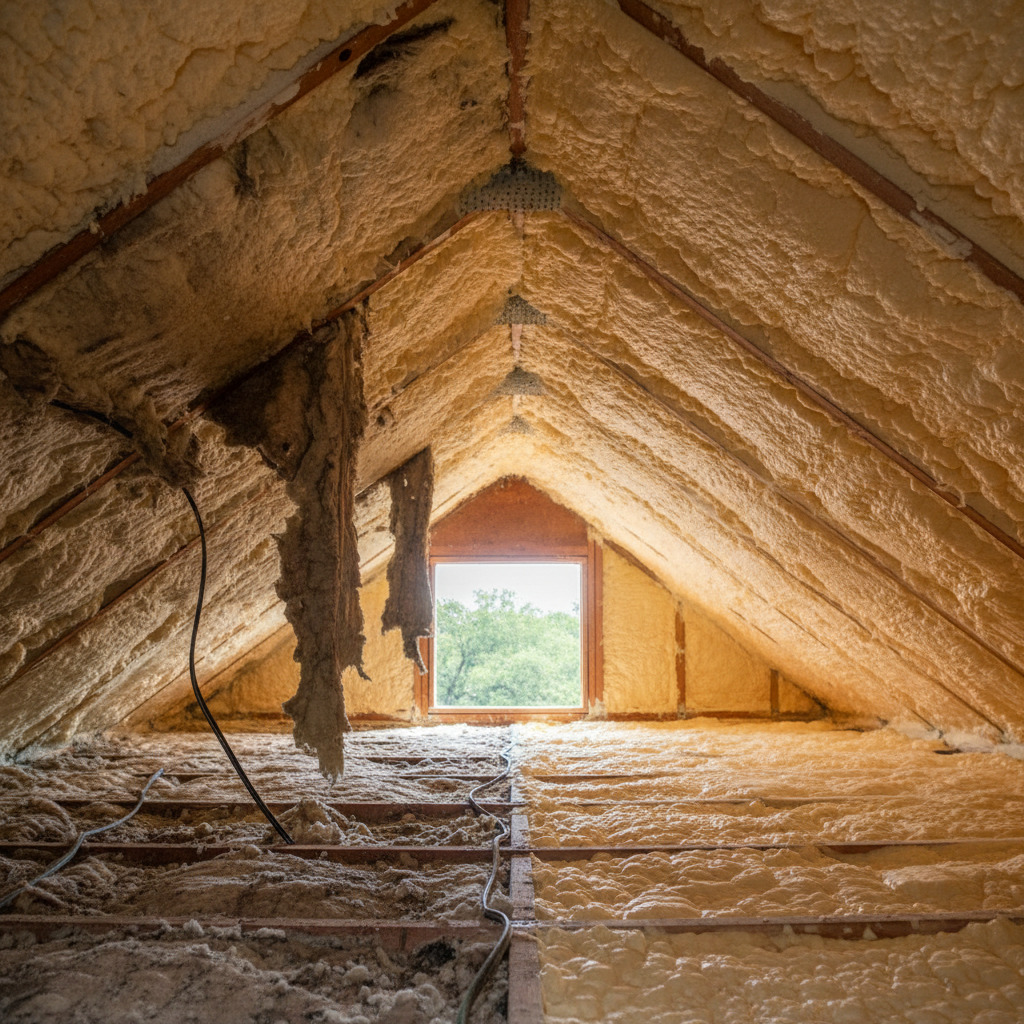
Alright, let's talk about closed-cell spray foam. If you're looking into insulating your home here in Irving, you've probably heard about it. It's tough stuff, great for our Texas heat, and does a fantastic job sealing up your house. But when it comes to applying it, there are generally two main ways we do it: what we call 'flash and batt' or 'flash and fill,' and then 'full-fill' closed-cell. People often get these mixed up, or don't even know there's a difference, so let's clear it up.
Flash and Batt (or Flash and Fill) Explained
So, what's flash and batt? It's pretty straightforward. We come in and spray a thin layer – usually about 1 to 2 inches – of closed-cell spray foam directly onto the sheathing or the surface we're insulating. This thin layer does a couple of really important things: it creates an excellent air barrier, stopping drafts dead in their tracks, and it adds a decent R-value too. After that closed-cell layer cures, we then come back and fill the rest of the cavity with traditional insulation, like fiberglass batts or blown-in cellulose. That's where the 'batt' part comes from.
Why do it this way? Well, it's often a cost-saving measure. Closed-cell foam, while amazing, can be pricier per inch than other insulation types. By using a thin layer for the air sealing and then cheaper material for the bulk R-value, you get a good balance of performance and budget. It's a popular choice for folks who want the benefits of spray foam's air sealing without the full expense of filling every cavity with it.
Full-Fill Closed-Cell Spray Foam
Now, full-fill closed-cell is exactly what it sounds like. Instead of just a thin layer, we fill the entire cavity – whether it's a wall cavity, a rim joist, or an attic rafter bay – with closed-cell spray foam. We're talking 3.5 inches in a 2x4 wall, 5.5 inches in a 2x6, or whatever thickness is needed to hit your desired R-value and fill that space completely.
This approach gives you maximum performance. You're not just getting an air barrier; you're getting a super-dense, high R-value insulation that also acts as a vapor barrier. It adds structural rigidity to your walls too, which is a nice bonus. For a lot of homeowners in older neighborhoods around Irving, like those beautiful mid-century homes near the University of Dallas, where you might have some settling or less-than-perfect framing, this can be a real game-changer for stability and energy efficiency.
Cost Comparison: What's the Damage?
Let's not beat around the bush, cost is a big factor. Generally speaking, flash and batt is going to be less expensive upfront than full-fill closed-cell. You're using less of the premium closed-cell foam. The exact savings depend on the size of the job and the R-value you're trying to achieve, but you can usually expect to pay less per square foot for the flash and batt method.
Full-fill, on the other hand, is a bigger investment. You're buying more of that high-performance material. However, you're also buying higher R-value per inch and superior air/vapor sealing. So while the initial cost is higher, the long-term energy savings and overall comfort can make it a very smart investment, especially with our scorching summers and the occasional cold snap here in North Texas.
Durability and Maintenance
Both methods, when done right, are incredibly durable. Closed-cell spray foam doesn't settle, sag, or degrade over time like some traditional insulations can. It's not a food source for pests, and it resists moisture, which is a huge plus in our humid climate. So, in terms of longevity, you're looking at a lifetime solution with either approach.
Maintenance? Practically none. Once it's installed, you don't really have to touch it. The only time you'd typically interact with it is if you're doing a major renovation and need to cut into a wall, but that's not 'maintenance' in the traditional sense.
Appearance (Behind the Walls)
Okay, appearance isn't usually a top concern since it's all hidden behind drywall, but there's a subtle difference. With flash and batt, you'll see that thin, rigid layer of foam, and then the fluffy or blown-in insulation filling the rest of the cavity. With full-fill, the entire cavity will be uniformly filled with the dense, rigid closed-cell foam. It looks very clean and complete, filling every nook and cranny. Again, not something you'll see daily, but it's a visual difference during installation.
My Recommendation for Irving Homeowners
So, which one should you choose for your Irving home? Here's my honest take: For most homeowners here, especially if you're looking for the absolute best performance and long-term energy savings, I lean towards full-fill closed-cell spray foam. Our summers are brutal, and having a completely sealed, high R-value envelope makes a massive difference in comfort and utility bills. The structural rigidity it adds is also a bonus for older homes.
However, if budget is a tighter constraint, or if you're upgrading insulation in an area where you already have some decent R-value but need serious air sealing, then flash and batt is a fantastic compromise. You still get that crucial air barrier from the closed-cell foam, which is often the biggest culprit for energy loss, and you can save some money on the bulk insulation.
Ultimately, it comes down to your specific goals and budget. What I always tell folks is to think about it as an investment. The energy savings from a well-insulated home, especially with closed-cell foam, really add up over the years. We've seen it time and again at Irving Spray Foam Insulation. If you're serious about cutting down those energy bills and making your home truly comfortable year-round, give us a call. We can walk through your place, talk about your options, and figure out what makes the most sense for you and your family.